Aging SPM’s: Replacement or refurbishment?
Riverlake has a wealth of experience in the development, operation and maintenance of single point mooring (SPM) systems at refineries or oil terminals for the (un)loading of tankers. This article provides an overview of the various challenges and options available to owners to extend the life of their ageing SPM systems.
Offshore refinery and tank farm infrastructure has high CAPEX and maintenance costs. At infrastructure end-of-life, after many years of proven successful operation, owners are faced with difficult and frequently high-cost decisions to maintain their ageing and mission critical assets in a safe and operational condition. To assist owners in making these decisions, several considerations for prolonging the residual operational life are described.
Background
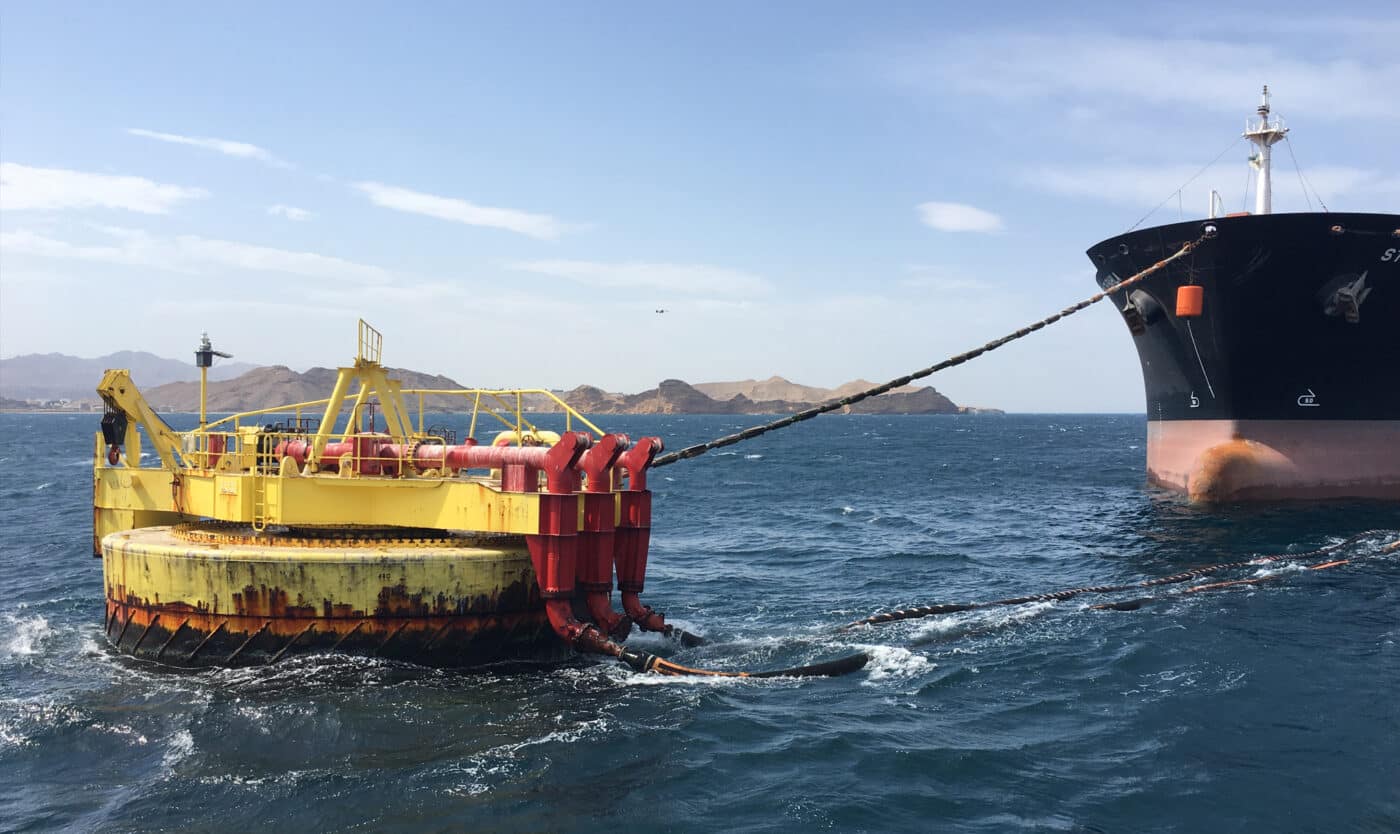
In locations where there is no port or land-based infrastructure, SPM systems are operational to serve as offshore tanker loading and unloading systems for refineries and tank farms. These SPM systems enable the safe mooring of tankers, while the product (e.g. white products, crude oil) is transferred via a subsea pipeline from/to onshore storage facilities. These SPM systems are designed to safely moor and discharge tankers of various sizes, up to VLCCs of over 300,000 tons deadweight.
Challenges
In total, there are currently around 400 of these SPM systems installed worldwide and a large number of SPM systems have been operating since the 1970s and 1980s. To date, only a minority of these systems have been replaced, leaving the bulk of these SPM systems at or near the end of their design life (or even beyond their expected life). The most prevalent problem is a damaged main bearing as a result of exposure to the weather or inadequate maintenance. This in many cases results in a lower weather criterion for mooring and berthing of tankers and consequently higher demurrage costs. In the worst case, a complete breakdown of the SPM system could occur. Another common problem is the leakage of a product swivel which is often “solved” by simply reducing the throughput capacity by pumping at a lower pressure. A reduced flow rate also results in higher demurrage costs.
Owner considerations
Due to the current low demand and oil prices, many owners are looking at the possibilities of deferring planned maintenance of ageing offshore infrastructure and/or considering alternative strategies to avoid downtime of their SPMs. Owners need to prepare for the worst-case scenario of a brutal SPM system failure that would be non-operational for weeks or months. Consequently, owners are expected to make plans to avoid SPM downtime and should at least consider the following:
— A strategic planning is required to minimize the out of service period. Do they have the knowledge of refurbishing or replacing a SPM?
— Prepare for high upfront Capex for all purchased SPM Systems. Do they have the financial capabilities?
— The owner shall manage various subcontractors (e.g. Engineering, SPM Supplier, Installation Contractor, and Testing & Commissioning) and interfaces. Do they have this project management experience and expertise?
Refurbishment or Replacement
The SPM can be refurbished or, in the event of a major retrofit, replaced with another SPM (note that this process also applies to subsea infrastructure such as pipelines and PLEMs). The asset owner shall take into account the future (expansion) plans of the complete infrastructure and define the required SPM lifetime. If the remaining lifetime of the existing SPM is less than the required lifetime, the owner shall prepare plans (including cost and schedule) to refurbish or replace the SPM in line with the required lifetime.
1. Refurbishment: the SPM can be refurbished between two tanker off-loadings to meet the required service lifetime. (Example: in the event of an expected failure of Product swivel seals, valves, telemetry).
— Prepare strategic spare part strategy.
— Purchase critical spares.
— Refurbish the SPM in accordance with the implementation strategy.
— Ensure specialised maintenance of the SPM during its residual lifetime.
— Keep sufficient (critical) spare parts in the warehouse.
2. Replacement: the SPM cannot be refurbished between two tanker off-loadings to meet the required service lifetime. (Example: in the event of an expected failure of Main bearing, loss of structural integrity).
— Purchase a new SPM to suit the functional requirements. Replace the existing SPM.
— Purchase a second-hand SPM, modify this SPM to suit the functional requirements, and required lifetime. Replace the existing SPM.
— Temporary lease or rent a suitable second-hand SPM. Replace with the existing SPM, which will be repaired at a yard / drydock. Reinstall once repairs are complete.
Once the existing SPM system is replaced, the critical spare part strategy and specialist maintenance as mentioned earlier is needed as a minimum to ensure a long and safe operational lifetime and a high uptime.
After the existing SPM system is being replaced, the critical spare parts strategy and specialist maintenance mentioned above are required as a minimum to ensure a long and safe operational life and high uptime.
Owners operating multiple SPMs may consider keeping a complete SPM buoy as a spare on site. This spare buoy can be refurbished and be rotated among the SPM pool to ensure high SPM operating time.
© 2021 Riverlake. All rights reserved.