Challenges and Potential of Ammonia as a Cleaner Marine Fuel in the Shipping Industry
Ammonia has garnered significant attention within the shipping industry as a promising solution to mitigate its environmental impact and meet the International Maritime Organization’s ambitious 2050 targets. However, despite considerable discussion spanning several years, its adoption has remained relatively slow. While pessimism persists, others view this compound as a potential game-changer. The sluggish progress can be attributed to numerous obstacles and challenges that have impeded its widespread implementation. Nonetheless, noteworthy projects and initiatives have emerged in recent years, seeking to overcome these barriers and propel its utilization as a cleaner marine fuel.
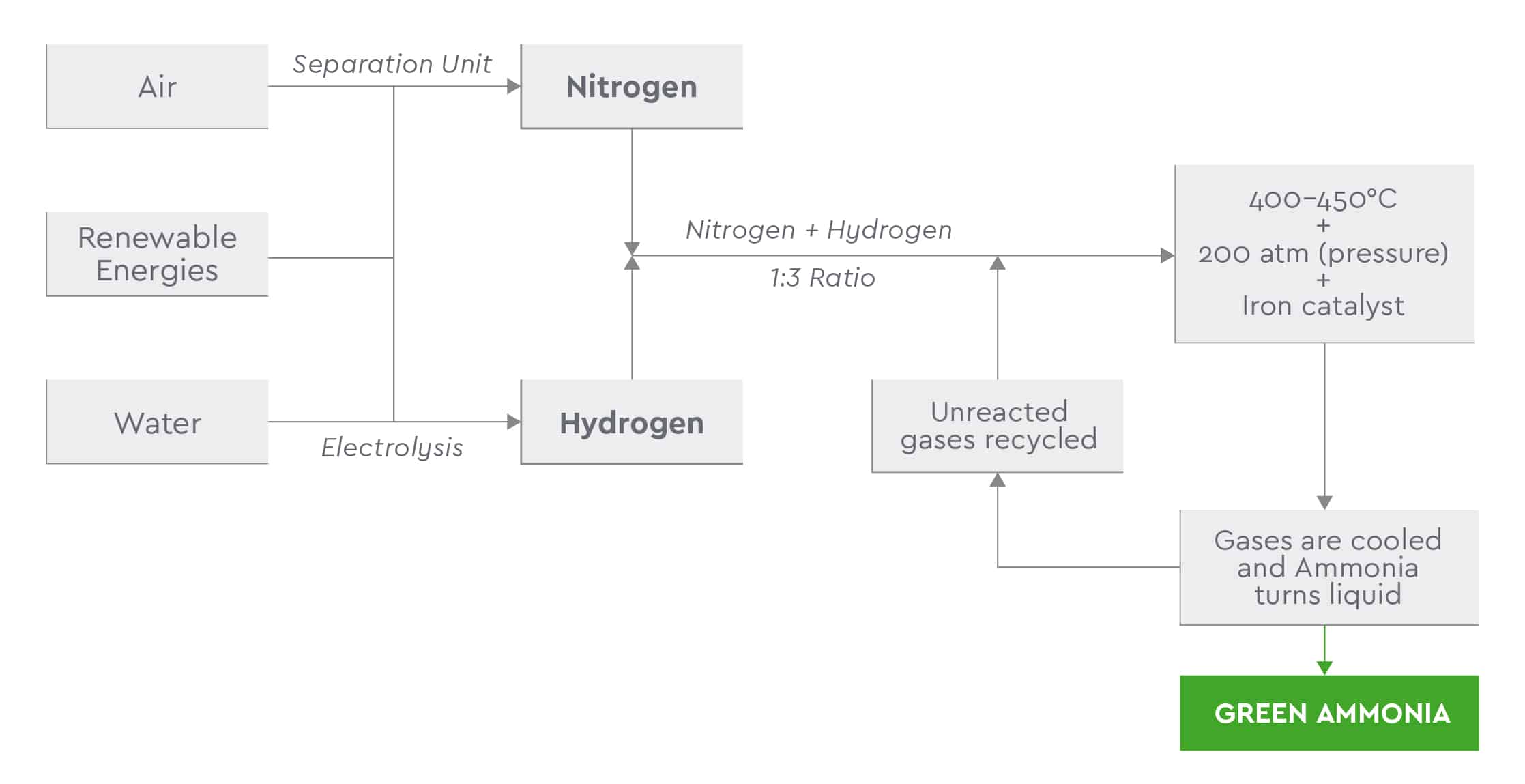
When produced in a carbon-neutral manner, it is commonly referred to as “Green Ammonia”. The chemical compound (NH3) is obtained by collecting hydrogen through the electrolysis of water, which can be powered by renewable energy sources such as solar, wind, and hydroelectric power. To obtain nitrogen, an air separation unit is required. To get the final compound at a commercial scale, producers currently use the so-called Haber-Bosch process (see Figure 1: Green Ammonia Process).
The product has high energy density making it well- suited for long-distance voyages requiring significant fuel. Compared to other biofuels, it benefits from an established transportation supply chain due to its widespread use in the fertilizer industry. Liquefied Petroleum Gas (LPG) tankers have long been capable of carrying it.
There are notable challenges hampering its quick adoption in shipping. The most important concern is its energy content, 18.6 MJ/Kg, which is more than half that of Gasoil, 44.34 MJ/Kg. The latter’s density (Kg/M3) is even higher than Ammonia’s, which means that more kilograms of product can be loaded in a similar volume.
It highlights that for a voyage requiring a certain amount of energy (in MJ), you would need to bunker more than twice as much Ammonia. Price comparisons should take this into account. The price of (Grey) Ammonia is around USD615/MT vs. around USD690/MT for Gasoil in Europe (June 2023). When we balance these with the fuels’ calorific values for the same voyage, we end up spending twice as much using Ammonia (around 2.125x more at today’s prices). Moreover, its low cetane number (indicating a longer auto-ignition time) makes applying it in combustion engines difficult. Indeed, its characteristics make that no vessels currently run on it.
Another factor is the lack of regulations concerning its combustion. Addressing this breach is crucial because it can lead to the formation of nitrogen oxides (NOx), which are harmful pollutants. Establishing robust regulations and emission standards is essential to ensure the fuel’s safe and environmentally friendly use. An additional challenge stems from the corrosive and toxic nature of the product. It requires careful management to prevent damage to engines, fuel systems, and storage facilities and ensure onboard personnel’s safety. On top of that, technological advancements are needed. Retrofitting existing vessels or designing new ones requires innovative solutions.This includes developing efficient combustion technologies, designing appropriate fuel storage systems, and creating engines capable of handling their unique properties.
Despite these obstacles, notable projects and initiatives aim to promote its use in the shipping industry. For example, WinGD, a Swiss marine engine maker, and Mitsubishi Shipbuilding Co. have signed a Memorandum of Understanding to collaborate on using Ammonia as a fuel. Another project is the acquisition of the Port of Stephenville by World Energy GH2. The company plans to establish the port as a Green Hydrogen and Ammonia shipping hub. The company aims to leverage the port’s strategic location in Newfoundland, Canada, to facilitate production, storage, and distribution.
In conclusion, Ammonia has the potential to reduce the environmental impact of the shipping industry, but its adoption has been slow due to challenges such as the lack of regulations, corrosiveness, infrastructure development, and technological advancements. However, notable projects and collaborations are underway to overcome these obstacles. With concerted efforts, the chemical can contribute to a more sustainable future for maritime transportation. Scaling up is needed as world production in 2022 was 150 million metric tons. At least 400 million metric tons would be necessary to only meet the total shipping demand, without taking other industries such as the fertilizers industry. The chemical compound’s major advantage will surely lie in its ability to store and transport hydrogen.
© 2023 Riverlake. All rights reserved.